
How Long Do Americans Wait To Have Sex?
Dating comes with plenty of unwritten rules, and few are debated more than when’s the right time to have sex for the first time. Some people trust the spark and go for it right away, others want more time to build comfort and connection before taking that step.
But how long do people actually wait, and how closely does real life match the timeline they think is ideal? To find out, we surveyed over 2,400 Americans across 48 states about their experiences with sex after a first date. We asked about their typical and quickest timelines, the importance of sexual chemistry and compatibility, and the pressures and expectations that can shape those decisions.
We then compared responses across the country to see where people tend to move fastest, where they take more time, and what Americans really think about sex, timing, and new relationships.
Standout Stats on Sexual Timing in Relationships
- Americans said 1 month is the typical amount of time to wait after a first date to have sex, with 34 of 48 states reporting a median of 30 days.
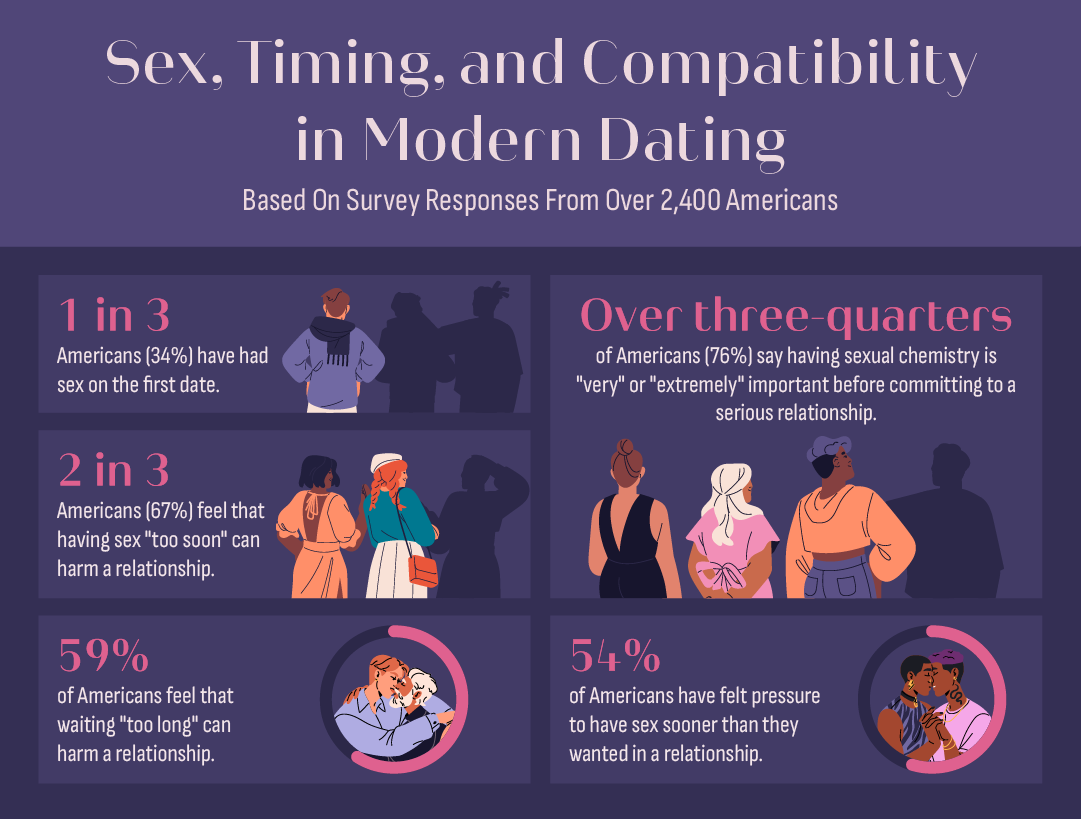
- More than 3 in 4 Americans (76%) said sexual chemistry is very or extremely important before committing to a serious relationship.
- Two-thirds of Americans believe having sex too soon can harm a relationship. 58% said waiting too long can also cause problems.
- More than half of Americans (54%) have felt pressured to have sex sooner than they wanted, including 66% of women and 38% of men.
How Long Does Every State Wait To Have Sex?
When it comes to sex after a first date, there’s no universal timeline. Some people are ready within days, while others prefer to let the connection develop for weeks, months, or longer.
Across the U.S., the median response to “How long have you typically waited to have sex with someone you’re interested in after the first date?” was 30 days. In fact, 34 of the 48 states surveyed landed on that same 30-day median.
But that national benchmark only tells part of the story. To see where timelines differed most, we grouped responses into four ranges: less than one week, one week to one month, one month to one year, and one year or more.
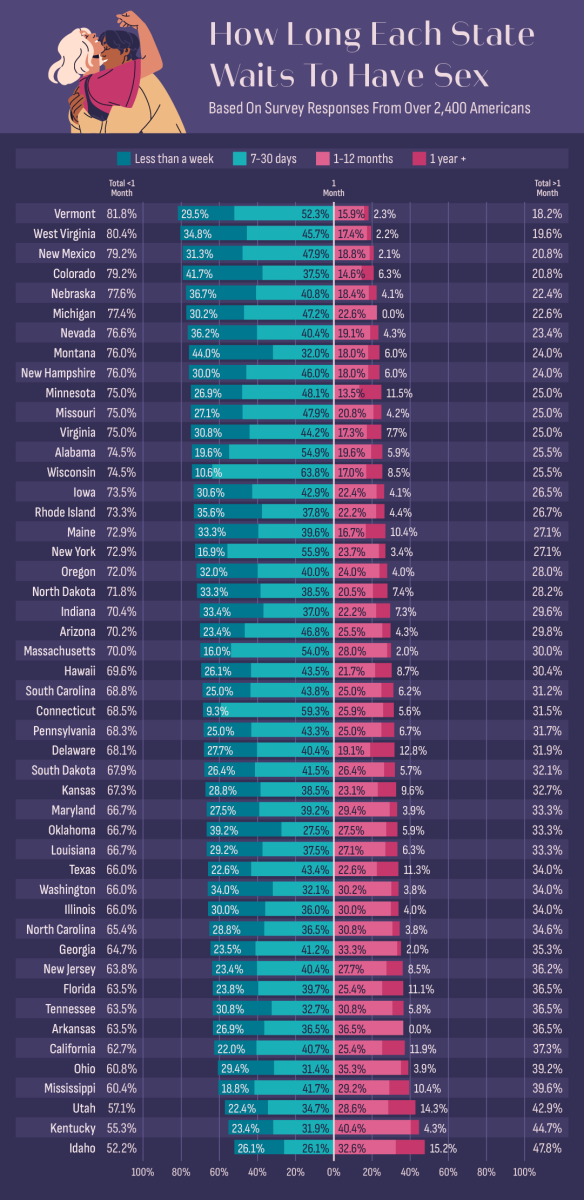
Where people are most likely to have sex within a month
In several states, waiting 30 days or less was especially common. More than 3 in 4 respondents in each of the following states said they typically had sex within a month of a first date:
- Vermont: 81.8%
- West Virginia: 80.4%
- New Mexico: 79.2%
- Colorado: 79.2%
- Nebraska: 77.6%
Vermont led the list, but the broader pattern shows that shorter timelines aren’t limited to one region. States across New England, the Mountain West, the Southwest, and the Midwest all appeared near the top.
Some respondents moved even faster. These states had the largest shares of people who said they typically had sex less than one week after a first date:
- Montana: 44.0%
- Colorado: 41.7%
- Oklahoma: 39.2%
Colorado stands out in both comparisons. Nearly 4 in 5 respondents there said they typically had sex within a month, while more than 2 in 5 said it usually happened within the first week.
The median timelines tell a similar story. While most states reported a median wait of 30 days, 14 came in below that mark:
- Maine: 26 days
- West Virginia: 25 days
- Virginia: 23 days
- North Dakota: 21 days
- New Hampshire: 21 days
- Vermont: 20.5 days
- New Mexico: 18 days
- Rhode Island: 16 days
- Montana: 15 days
- Colorado: 15 days
- Nevada: 15 days
- Nebraska: 14 days
- Oklahoma: 14 days
- Iowa: 14 days
The shortest median wait was 14 days, reported in Nebraska, Oklahoma, and Iowa. Even among the states with faster timelines, though, the results suggest that “soon” often means a couple of weeks rather than immediately after the first date.
Where people are more likely to wait at least a month
At the other end of the spectrum, some states had much larger shares of respondents who said they typically waited one month or more:
- Idaho: 47.8%
- Kentucky: 44.7%
- Utah: 42.9%
- Mississippi: 39.6%
- Ohio: 39.2%
Idaho had the highest share, with nearly half of respondents saying they generally waited at least a month. Kentucky and Utah followed closely behind.
Waiting a year or more was less common overall, but it still represented a notable share of responses in a few states:
- Idaho: 15.2%
- Utah: 14.3%
- Delaware: 12.8%
Idaho and Utah appear in both of the longest-waiting groups, suggesting that respondents in these states were more likely to prefer a slower timeline overall.
The state-level findings show plenty of variation, but they also reveal a common middle ground. Most states shared a median wait of 30 days, while the states on either end reflected different approaches to comfort, chemistry, and relationship pacing.
Of course, a timeline alone can’t explain why someone chooses to have sex sooner or later. Next, we’ll take a closer look at what shapes that decision, including sexual chemistry, compatibility, dating expectations, and outside pressure.
What Americans Think About Sex in Relationships
The regional results show that people move at different speeds. But timing is only one part of the decision. Across the country, people are also weighing chemistry, compatibility, relationship expectations, and the pressure to follow dating rules that may not fit them.
Our survey shows that Americans don’t always follow the timeline they consider ideal, and that the “right” moment can feel complicated when personal comfort, attraction, and outside expectations all come into play.
One month may be the ideal, but plenty of people move faster
When asked how long someone should ideally wait to have sex after a first date, Americans landed on one full month. That lines up with the typical 30-day wait reported elsewhere in the survey.
Still, real-life dating doesn’t always follow the ideal timeline. About 1 in 3 Americans said the quickest they’ve had sex with someone was on the first date.
Age adds another wrinkle. Gen Z were actually the least likely age group to say they typically have sex within a month of a first date. Just 58% did so, compared with 70% of millennials and 75% of Gen X. So, despite stereotypes about younger daters moving quickly, the youngest adults in our survey reported taking the most time.
That gap suggests that people may have a general timeline in mind while still making decisions based on the connection in front of them. Attraction, trust, excitement, and circumstance can make things move at different paces.
Sexual chemistry matters to most Americans
Timing may get plenty of attention, but compatibility appears to matter even more. More than three-quarters of Americans said sexual chemistry is highly important before committing to a serious relationship:
- 76% said sexual chemistry is “very” or “extremely” important.
- Just 5% said it is “not very” or “not at all” important.
That sentiment held fairly steady across age groups. At least 74% of respondents in every age bracket said sexual chemistry is very or extremely important, rising to 80% among baby boomers.
For many, this can shape whether a relationship moves forward at all. Nearly half of respondents said they have ended or reconsidered a relationship because of sexual incompatibility. That includes 30% who ended the relationship.
Another 22% said they had experienced sexual incompatibility but chose not to end the relationship because of it.
Sexual compatibility can carry real weight, but it isn’t always treated as a deal breaker. For some couples, communication, connection, and a willingness to learn together may matter just as much as immediate chemistry.
Can having sex too soon (or waiting too long) hurt a relationship?
Americans appear to see risks on both ends.
Two-thirds of respondents said having sex “too soon” can harm a relationship. At the same time, 58% said waiting “too long” can also have a negative effect.
The largest differences appeared between men and women:
- 73% of women said having sex too soon can harm a relationship, compared with 59% of men.
- 66% of men said waiting too long can harm a relationship, compared with 53% of women.
Age also shaped which end of the timeline felt riskier. Younger respondents were more likely to worry about waiting too long, while older adults were more cautious about moving too quickly:
- 63% of Gen Z said waiting too long can harm a relationship, compared with 47% of baby boomers.
- 74% of baby boomers said having sex too soon can harm a relationship, compared with 68% of Gen Z.
Together, the results point to a tension that many daters may recognize. Moving quickly can bring concerns about expectations, trust, or judgment, while waiting can create uncertainty about attraction or compatibility.
But “too soon” and “too long” are personal measures. A healthy timeline is one that works for everyone involved and leaves room for honest conversations about comfort, boundaries, and desire.
Pressure still plays a major role in dating
Even when people know what feels right for them, they may still feel pressure to move faster. More than half of respondents said they have felt pressured to have sex sooner than they wanted in a relationship.
That experience was far more common among women:
- 66% of women said they had felt pressured to have sex before they were ready.
- 38% of men said the same.
The difference is a reminder that sex-positive dating isn’t just about feeling free to say yes. It also means feeling equally free to say no, slow down, or change your mind without judgment or pressure.
Many traditional dating rules no longer fit
Americans also appear ready to leave several long-standing dating expectations behind. The rules respondents were most likely to call outdated were:
- Judging someone for having sex too soon: 27%
- Assuming sex means the relationship is serious: 16%
- Waiting a set number of dates before having sex: 14%
The most common answer is especially telling. People may still worry that having sex too soon could affect a relationship, but many also reject the idea that someone should be judged for making that choice.
People care deeply about sexual chemistry and recognize that timing can influence a relationship. But there is no single schedule that guarantees success. Whether sex happens on the first date, after 30 days, or much later, the strongest approach is one built around mutual desire, clear communication, and a timeline that feels right for everyone involved.
So, When Is the Right Time to Have Sex?
The survey shows that people have plenty of opinions about when sex should happen, but the numbers also make one thing clear: there’s no universally agreed-upon timeline. So what should people actually consider when deciding whether they’re ready?
We asked Dr. Shamyra Howard, Womanizer Sex & Relationship Expert, to weigh in on sexual timing, the stigma around having sex “too soon,” and what matters more than counting days or dates.
Q: Is there a certain amount of time you recommend people wait before having sex with a new partner?
A: I don’t recommend a specific number of dates, days, or months. There isn’t a magic timeline that makes sex more likely to lead to a healthy relationship. I recommend people assess their own readiness for sex, rather than just how much time they should wait.
Before having sex with someone new, I’d want people to feel like they can answer a few basic questions. Do I actually want this, or am I doing it because I’m afraid they’ll lose interest? Do I feel comfortable communicating what I like and don’t like? Can we talk about condoms, contraception, STI testing, and boundaries without it becoming awkward or evasive? And importantly, am I comfortable with the possibility that having sex may not turn this into a relationship?
You can know someone for three months and still not be ready for sex with them. You can also have sex relatively early and go on to have a wonderful, committed relationship. The calendar doesn’t tell us nearly as much as the circumstances surrounding the decision.
Q: Why is there stigma around having sex with a partner “too soon”?
A: A lot of stigma around having sex too soon comes from old sexual scripts about what respectable dating is supposed to look like, and women have historically carried far more of the judgment. We’ve been taught that sex is something women should withhold and men should pursue, and that waiting somehow increases a woman’s value or a man’s respect for her. Those ideas still show up in modern dating, even when people think they’ve moved beyond them.
There’s also the desire to control. Many people think if they wait until a certain date to have sex, they’ll be taken more seriously. Unfortunately, relationships don’t work that way. I’d rather people ask, What does having sex mean to each of us? One person may experience sex as part of getting to know someone, while another becomes emotionally attached very quickly through sexual intimacy. Neither is inherently wrong, but that difference matters.
Q: Two-thirds of Americans believe having sex too soon can harm a relationship. 58% said waiting too long can also cause problems. Do you have any thoughts on this?
A: I think those findings illustrate something important. People recognize that timing matters, but there isn’t agreement about what the right timing is. Having sex early can create problems when people haven’t discussed expectations and then discover afterward that they assigned completely different meanings to the experience. But waiting can create its own tension when someone is postponing sex because they’re following an arbitrary dating rule, testing the other person’s commitment, or avoiding a conversation about sexual compatibility. One question people can ask to help them make the decision is, Do we know enough about ourselves and each other to make the decision intentionally?
Beyond the Dating Timeline
Americans may have a 30-day ideal in mind, but the survey makes one thing clear: real-life intimacy rarely follows a fixed schedule. Timing varies by state, by relationship, and by the people involved.
What matters more than counting days or dates is feeling comfortable, communicating openly, and paying attention to chemistry and compatibility. Whether sex happens quickly or much later, the right pace is the one everyone involved genuinely wants.
That’s closely connected to Womanizer’s belief that sexual fulfillment starts with knowing your body, expressing what you want, and approaching pleasure without shame. Explore our sex toys and read from our network of sexual wellness experts to keep learning what feels right for you.
Methodology
To better understand how Americans think about sexual timing, dating expectations, and relationship compatibility, we surveyed over 2,400 U.S. adults from 48 states. Respondents were asked a series of structured questions about how long they believe people should wait to have sex after a first date, how long they have typically waited in their own dating lives, and how timing has affected their relationships.
For the purposes of this survey, “sex” was defined as any consensual sexual activity with another person, including oral, vaginal, or anal sex. Questions were designed to compare personal behavior with perceived ideals, allowing for analysis of the gap between how long people think they should wait and what they actually do in practice.
Additional questions explored the role of sexual chemistry, pressure, judgment, sexual compatibility, and whether respondents felt having sex too soon or waiting too long had ever helped or hurt a relationship.
The survey was conducted online among a state-by-state sample of U.S. adults. All responses were anonymous, and results are reported in aggregate.
Fair Use
You are welcome to use, reference, and share non-commercial excerpts of this study with proper attribution. If you cite or cover our findings, please link back to this page so readers can view the full methodology, charts, and context.